Analisis Kemampugaruan dan Kemampugalian Batuan Peridotit Kabupaten Morowali Utara, Provinsi Sulawesi Tengah
DOI:
https://doi.org/10.56099/ophi.v7i1.p43-48Keywords:
kemampugalian, kemampugaruan, spasi kekar, metode penambangan, peridotitAbstract
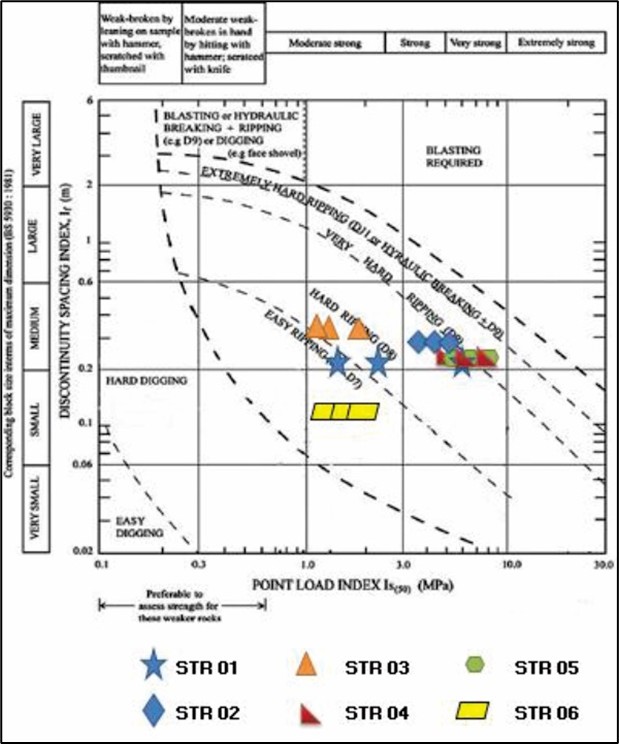
In lateritic nickel mining, peridotite rock serves not only as the primary source of nickel laterite but also plays a crucial role in slope design and the development of mining infrastructure, such as the construction of mine roads. Additionally, economically non-viable peridotite can be repurposed as fill material or construction raw material if it meets specific technical criteria. This study aims to analyze the ripperability and abrasiveness of peridotite rock in the research area to determine the most effective excavation method. The analysis was conducted using joint spacing data and rock strength obtained through measurements of rock mass discontinuities using the scanline survey, uniaxial compressive strength (UCS) tests, and point load tests. The findings indicate that the rock in the study area can be classified into three main categories based on joint spacing and strength: easy ripping, hard ripping, and very hard ripping. Based on the analysis, the recommended heavy equipment includes Bulldozer models D7G and D8K, which are suitable for the rock rippability categories identified at the site. Rocks with high strength values exhibit high abrasiveness, leading to accelerated wear on heavy machinery. Therefore, selecting wear-resistant equipment and implementing more intensive maintenance planning are essential to improving operational efficiency in the study area.
References
Bermana, I. 2006. Klasifikasi geomorfologi untuk pemetaan geologi yang telah dibakukan, Bulletin of Scientific Contribution, 4(2), pp. 161-173.
Badan Informasi Geospasial. 2014. Digital Elevation Model Nasional. https://tanahair.indonesia.go.id/portal-web/
Bieniawski, Z. T. & Bernede, M. J. 1979. Suggested methods for determining the uniaxial compressive strength and deformability of rock materials. International Journal of Rock Mechanics and Mining Sciences & Geomechanics Abstracts, 16(2), pp. 138-140. https://doi.org/10.1016/0148-9062(79)91451-7
Caterpillar. 2019. Caterpillar Performance Handbook. 49th ed. USA: Caterpillar Ltd.
Cobîrzan, N., Muntean, R., Thalmaier, G., & Felseghi, R.A. 2022. Recycling of Mining Waste in the Production of Masonry Units. Materials, 15(2), pp. 594. https://doi.org/10.3390/ma15020594
Dagdelenler, G. 2021. Comparison of the efficiency evaluations of selected excavatability classifications for rock masses. Arabian Journal of Geosciences, 14(13), pp. 1281. https://doi.org/10.1007/s12517-021-07553-x
Fookes, P.G., Dearman, W.R. & Franklin, J.A. 1971. Some engineering aspects of rock weathering with field examples from Dartmoor and elsewhere. Quarterly Journal of Engineering Geology and Hydrogeology, 4(3), pp. 139-185. https://doi.org/10.1144/GSL.QJEG.1971.004.03.01
Firdaus, A.N., Indrawan, G.B. & Wamnada, V.W. 2021. Characteristic of rock masses and the influence of weathering on engineering properties of andesite breccia. AIP Conference Proceedings, 2383(1), pp. 040021. https://doi.org/10.1063/5.0061094
Gurocak, Z. & Yalcin, E. 2016. Excavatability and the effect of weathering degree on the excavatability of rock masses: An example from Eastern Turkey. Journal of African Earth Sciences, 118, pp. 1-11. https://doi.org/10.1016/j.jafrearsci.2016.02.017
Irfan, T.Y. & Dearman, W.R. 1978. Engineering classification and index properties of a weathered granite, Bulletin of the International Association of Engineering Geology, 17, pp. 79-90. https://doi.org/10.1007/BF02634696
Kesimal, A., Karaman, K., Cihangir, F., & Ercikdi, B. 2018. Excavatability Assessment of Rock Masses for Geotechnical Studies. In N. Ceryan (Ed.), Handbook of Research on Trends and Digital Advances in Engineering Geology. pp. 231-256. IGI Global Scientific Publishing. https://doi.org/10.4018/978-1-5225-2709-1.ch006
Priest, S. D. & Hudson, J. A. 1976. Discontinuity spacings in rock. International Journal of Rock Mechanics and Mining Sciences & Geomechanics Abstracts, 13(5), pp. 135-148. https://doi.org/10.1016/0148-9062(76)90818-4
Pettifer, G. S. & Fookes, P. G. 1994. A revision of the graphical method for assessing the excavatability of rock. Quarterly Journal of Engineering Geology, 27(2), pp. 145-164. https://doi.org/10.1144/gsl.Qjegh.1994.027.P2.05
Su, P.C., Wang, W.S., Huo, J.H. & Li, Z. 2010. Optimal layout design of cutters on tunnel boring machine, Journal of Northeastern University, 31(6), pp. 877–881.
Surono & Hartono, U. 2013. Geologi Sulawesi (1 ed.). Jakarta, LIPI Press.
Thornbury, W. D. 1989. Principle of Geomorphology. London, Prentice Hall India Privated Limited.
Wen, S. & Huang, P. 2017. Principles of Tribology. 2nd ed. Beijing. Tsinghua University Press. https://doi.org/10.1002/9781119214908
Wijk, G. 1992. A model of tunnel boring machine performance, Geotechnical and Geological Engineering, 10, pp. 19-40. https://doi.org/10.1007/BF00881969
Wang, R., Wang, Y., Li, J., Jing, L., Zhao, G. & Nie, L. 2020. A TBM cutter life prediction method based on rock mass classification, KSCE Journal of Civil Engineering, 24(9), pp. 2794-2807. https://doi.org/10.1007/s12205-020-1511-2
Downloads
Published
How to Cite
Issue
Section
License
Copyright (c) 2025 Amritzal Nur Firdaus, Isman Saleh, Iswandi Utama

This work is licensed under a Creative Commons Attribution-ShareAlike 4.0 International License.