Studi Alterasi dan Mineralisasi Endapan Hidrotermal di Daerah Jampea, Selayar, Sulawesi Selatan
DOI:
https://doi.org/10.56099/ophi.v7i2.p104-111Keywords:
alterasi, bijih, hidrotermal, mineralisasi, sulfidaAbstract
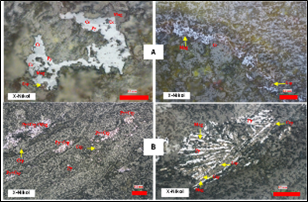
The sulfide mineralization at each location has distinct mineralization and alteration characteristics depending on its genesis and aspects not previously studied by researchers. This includes the research location, Jampea Island, which requires further identification of several aspects related to sulfide mineralization, such as hydrothermal alteration characteristics, ore and gangue mineral assemblages, mineralization types, and the range of formation temperatures and pH of the hydrothermal fluids that formed them. This study aims to analyze the ore mineral assemblages along with their formation sequence, determine the types of alteration in the research area, and establish a genetic model of sulfide mineralization in the research area. The research was conducted in several stages, including field data collection (samples, location plotting, and documentation), sample preparation, followed by data processing through laboratory analyses consisting of petrographic analysis, mineragraphic analysis, and XRD (X-Ray Diffraction). The results indicate that granite and diorite act as the host rocks for mineralization in the research area. The alteration mineral assemblages associated with mineralization in the research area include quartz, sericite, calcite, chlorite, alkali feldspar, epidote, and dolomite. There are three alteration zones: propylitic, phyllic, and potassic. Mineralization in the research area formed within a temperature range of 200–320°C, with hydrothermal fluid pH ranging from acidic to neutral. The resulting ore mineral assemblages consist of two types: hypogene and supergene, with the minerals including: pyrite, chalcopyrite, bornite, magnetite, chalcocite, and covellite.
References
Alt, J. C. & Teagle, D. A. H. 2000. Hydrothermal alteration and fluid fluxes in ophiolites and oceanic crust. In: Dilek, Y., Moores, E. M., Elthon, D. & Nicolas, A. (eds.) Ophiolites and oceanic crust: new insights from field studies and the Ocean Drilling Program. Geological Society of America. https://doi.org/10.1130/0-8137-2349-3.273
Burnham, C.W., 1962. Facies and types of hydrothermal alteration. Economic Geology, 57, pp. 768–784. https://doi.org/10.2113/gsecongeo.57.5.768
Corbett, G. J. & Leach, T. M. 1998. Southwest Pacific Rim Gold-Copper Systems. Australia, Society of Economic Geologists. https://doi.org/10.5382/SP.06
Czamanske, G.K., 1974. The FeS Content of Sphalerite Along the Chalcopyrite-Pyrite-Bornite Sulfur Fugacity Buffer. Economic Geology, 69(8), pp. 1328–1334. https://doi.org/10.2113/gsecongeo.69.8.1328
Elburg, M.A. & Foden, J., 1999. Geochemical response to varying tectonic settings: An example from southern Sulawesi (Indonesia). Geochimica et Cosmochimica Acta, 63, pp. 1155–1172. https://doi.org/10.1016/S0016-7037(98)00298-1
Husain, R., Kaharuddin, K., & Wahyu, F., 2023. Karakteristik Olistolit Daerah Tondong Tallasa, Sulawesi Selatan. Jurnal Goesapta, 9(2), pp. 111-116. https://doi.org/10.20527/jg.v9i2.16423
Hüseyinca, M. Y., & Küpeli, S. 2022. Geochemistry of Upper Eocene-Oligocene sandstones from Tuzgölü Basin (Central Anatolia). Niğde Ömer Halisdemir Üniversitesi Mühendislik Bilimleri Dergisi, 11(1), pp. 157-169. https://doi.org/10.28948/ngumuh.1018818
Imran, A.M., 2023. Pengantar Geologi Batuan Karbonat. Yogyakarta. Penerbit K-Media.
Irzon, R. 2015. Genesis Granit Muncung dari Pulau Lingga Berdasarkan Data Geokimia dan Mikroskopis. Jurnal Geologi dan Sumberdaya Mineral, 16(3), pp. 141-149. https://doi.org/10.33332/jgsm.geologi.v16i3.38
Kandora, T.A.H., Nur, I., Irfan, U.R., 2022. Preliminary Study; Hidrothermal Alteration on Supergene Copper Deposits in Tonra Area Bone Regency South Sulawesi Province. Jurnal Geocelebes, 6(2), pp. 187–193. https://doi.org/10.20956/geocelebes.v6i2.20431
Katili, J. A. 1978. Past and present geotectonic position of Sulawesi, Indonesia. Tectonophysics, 45(4), pp. 289-322. https://doi.org/10.1016/0040-1951(78)90166-x
Lay, A.S.P.D. & Qodri, M.F., 2023. Kontrol Geologi Terhadap Alterasi dan Mineralisasi Daerah Jladri, Karangbolong, Jawa Tengah. Prosiding Nasional Rekayasa Teknologi Industri dan Informasi XVIII, pp. 376–382.
Mathieu, L. 2018. Quantifying Hydrothermal Alteration: A Review of Methods. Geosciences, 8(7), pp. 245. https://doi.org/10.3390/geosciences8070245
Pirajno, F. (2009). Skarn Systems. pp. 535-580. In: Hydrothermal Processes and Mineral Systems. Springer, Dordrecht. https://doi.org/10.1007/978-1-4020-8613-7_6
Schwenzer, S. P., & Kring, D. A. 2013. Alteration minerals in impact-generated hydrothermal systems–Exploring host rock variability. Icarus, 226(1), 487-496.
Sharma, R., Srivastava, P.K. 2014. Hydrothermal Fluids of Magmatic Origin, pp. 181-208. In: Kumar, S., Singh, R. (eds) Modelling of Magmatic and Allied Processes. Society of Earth Scientists Series. Springer, Cham. https://doi.org/10.1007/978-3-319-06471-0_9
Sillitoe, R.H., 1996. Granites and metal deposits. Episodes, 19(4), pp. 126-133. https://doi.org/10.18814/epiiugs/1996/v19i4/006
Soeharto, R. S. 2000. Hasil Ekplorasi Mineral Logam di Jalur Busur Magmatik Sunda-Banda. Kolokium Hasil Kegiatan Lapangan DSM–2000, didownload dari http://psdg.bgl.esdm.go.id/kolokium/
Sofwan, E. & Dayandini, H. P. 2025. Tantangan dan Peluang Hilirisasi Pertambangan Komoditas Mineral Batubara Menuju Indonesia Emas 2045 : Evaluasi Penegakan Hukum dan Penataan Administrasi Perizinan Tambang. Jurnal Rechts Vinding: Media Pembinaan Hukum Nasional, 14(1), pp. 107–123. https://dx.doi.org/10.33331/rechtsvinding.v14i1.2156
Warren, I., Simmons, S.F., Mauk, J.L., 2007. Whole-rock geochemical techniques for evaluating hydrothermal alteration, mass changes, and compositional gradients associated with epithermal Au-Ag mineralization. Economic Geology, 102(5), pp. 923–948. https://doi.org/10.2113/gsecongeo.102.5.923
Downloads
Published
How to Cite
Issue
Section
License
Copyright (c) 2025 Andi Febby Alvionita, Muhammad Rivaldi Amri, Irzal Nur, Sri Widodo

This work is licensed under a Creative Commons Attribution-ShareAlike 4.0 International License.